Narrowband Imaging: Ha, OIII, and SII Explained
Narrowband imaging is arguably the most powerful technique in amateur astrophotography. By isolating specific emission lines from ionized gas, you can produce scientifically rich, visually stunning images that broadband simply cannot match.
What Is Narrowband?
Nebulae emit light at very specific wavelengths corresponding to the spectral lines of ionized elements:
| Filter | Element | Wavelength | Color |
|---|---|---|---|
| Ha | Hydrogen-alpha | 656 nm | Deep red |
| OIII | Doubly ionized oxygen | 496 + 501 nm | Blue-green |
| SII | Singly ionized sulfur | 672 nm | Far red |
Narrowband filters (typically 3–7 nm bandpass) block almost all other light and transmit only these precise wavelengths. The result:
- Immune to light pollution — sodium streetlights, LED glow, moon all blocked
- High contrast — faint nebulosity pops against dark background
- Unique color mappings — Hubble Palette gives nebulae their iconic gold-teal-blue look
The Hubble Palette (SHO)
The most famous narrowband color mapping assigns:
- Red channel → SII
- Green channel → Ha
- Blue channel → OIII
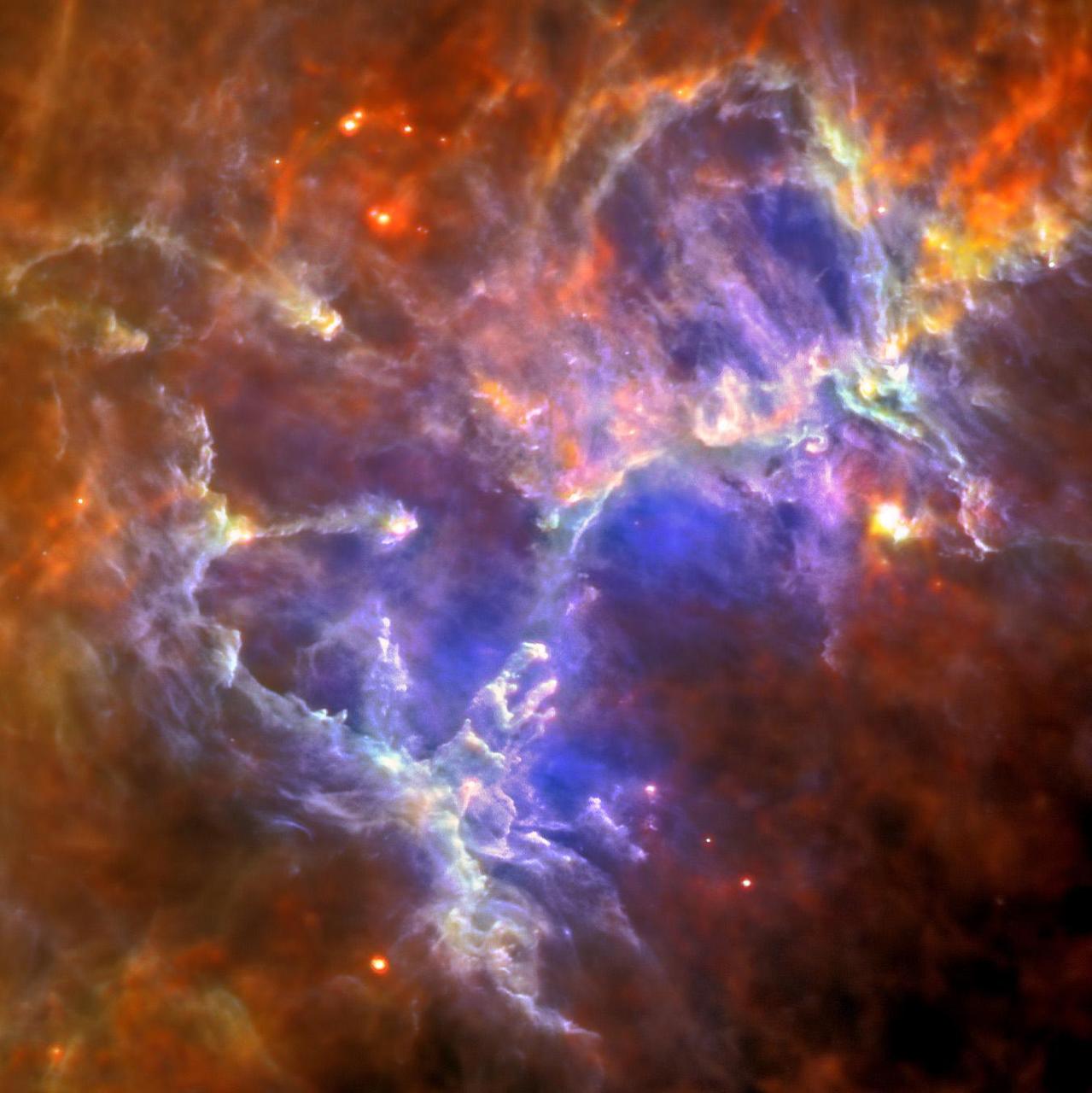
This is called the Hubble Palette or SHO mapping. It's what gives iconic nebulae like the Eagle Nebula (Pillars of Creation) and Crab Nebula their distinctive color scheme.
The mapping is scientifically meaningful: regions with high sulfur emission (older, cooler, denser gas) appear gold/orange, while doubly-ionized oxygen (hotter, more energetic regions) appears blue.
HOO — A Simpler Two-Filter Approach
If you're starting with narrowband, the HOO palette is a great entry point:
- Red → Ha
- Green → OIII
- Blue → OIII
This works beautifully on emission nebulae and requires only two filters. Integration time can be split as ~60% Ha / 40% OIII. The results look similar to true-color but with much better signal-to-noise.
Integration Time Requirements
Narrowband demands longer exposures than broadband because the filter blocks >99% of incoming light. Practical minimums:
Ready to capture the universe?
Professional telescope access from $79/night. Our team handles everything — you process the data.
Book Your Night — From $79Want to rent a telescope online · Read our remote telescope rental guide · Browse astrophotography datasets
- Ha: 10–20 hours for good SNR on bright nebulae (IC 1805, Rosette, etc.)
- OIII: 12–25 hours (fainter signal than Ha for most objects)
- SII: 15–30 hours (often the faintest of the three)
A full SHO image of a moderately faint target might require 40–60 total hours of integration. This is why remote telescope services that can accumulate data across multiple nights are invaluable.
Choosing Your Targets
Not all nebulae are good narrowband targets. Look for:
Excellent narrowband targets:
- Emission nebulae — IC 1805, IC 1848, NGC 7293 (Helix), NGC 6992 (Eastern Veil)
- Supernova remnants — Cygnus Loop, Simeis 147
- Planetary nebulae — M27 (Dumbbell), M57 (Ring)
Poor narrowband targets:
- Reflection nebulae (e.g. M45) — no ionized gas, won't emit in narrowband
- Galaxies — you'll capture Ha from HII regions but miss broadband detail
- Star clusters — no diffuse emission
Processing Narrowband Data
Once you have Ha, OIII, and SII data, the processing workflow differs from broadband:
- Process each filter independently — calibrate, stack, stretch each channel separately
- Assign channels — map Ha→R, OIII→G/B, SII→R in your preferred palette
- Handle the green star problem — in SHO, stars appear green because Ha doesn't dominate star color. Fix with star color techniques in PixInsight or Siril
- Combine layers — use Screen combination or luminosity blending for clean stars
- Balance — use the Foraxx palette or subtle hue shifts to personalize colors
Our Narrowband Datasets
All SkyShare Astro narrowband datasets include:
- Individual Ha, OIII, and SII stacks (when applicable)
- Master calibration frames for each filter
- Acquisition report with per-filter integration times
- README with suggested processing parameters
Whether you purchase Ha-only for a simple HOO composite, or a full SHO dataset for a complete palette image, you'll have professional-grade data to work with.
The universe is full of ionized gas — narrowband lets you see it.
Ready to capture the universe?
Professional telescope access from $79/night. Our team handles everything — you process the data.
Book Your Night — From $79Want to rent a telescope online · Read our remote telescope rental guide · Browse astrophotography datasets