What Is Bortle 1? Why Sky Darkness Changes Everything in Astrophotography
The Bortle scale is the single most important factor in astrophotography — more than telescope aperture, camera sensor size, or total exposure time. A truly dark Bortle 1 sky doesn't just improve your images; it reveals objects that are invisible no matter how long you expose from a bright location.
What Is the Bortle Scale?
The Bortle Dark-Sky Scale is a nine-level numeric scale that measures the darkness of the night sky at a given location. Created by amateur astronomer John E. Bortle and first published in Sky & Telescope in 2001, it gives astronomers a standardized, practical language for describing observing conditions.
The scale runs from 1 (darkest) to 9 (brightest urban glow):
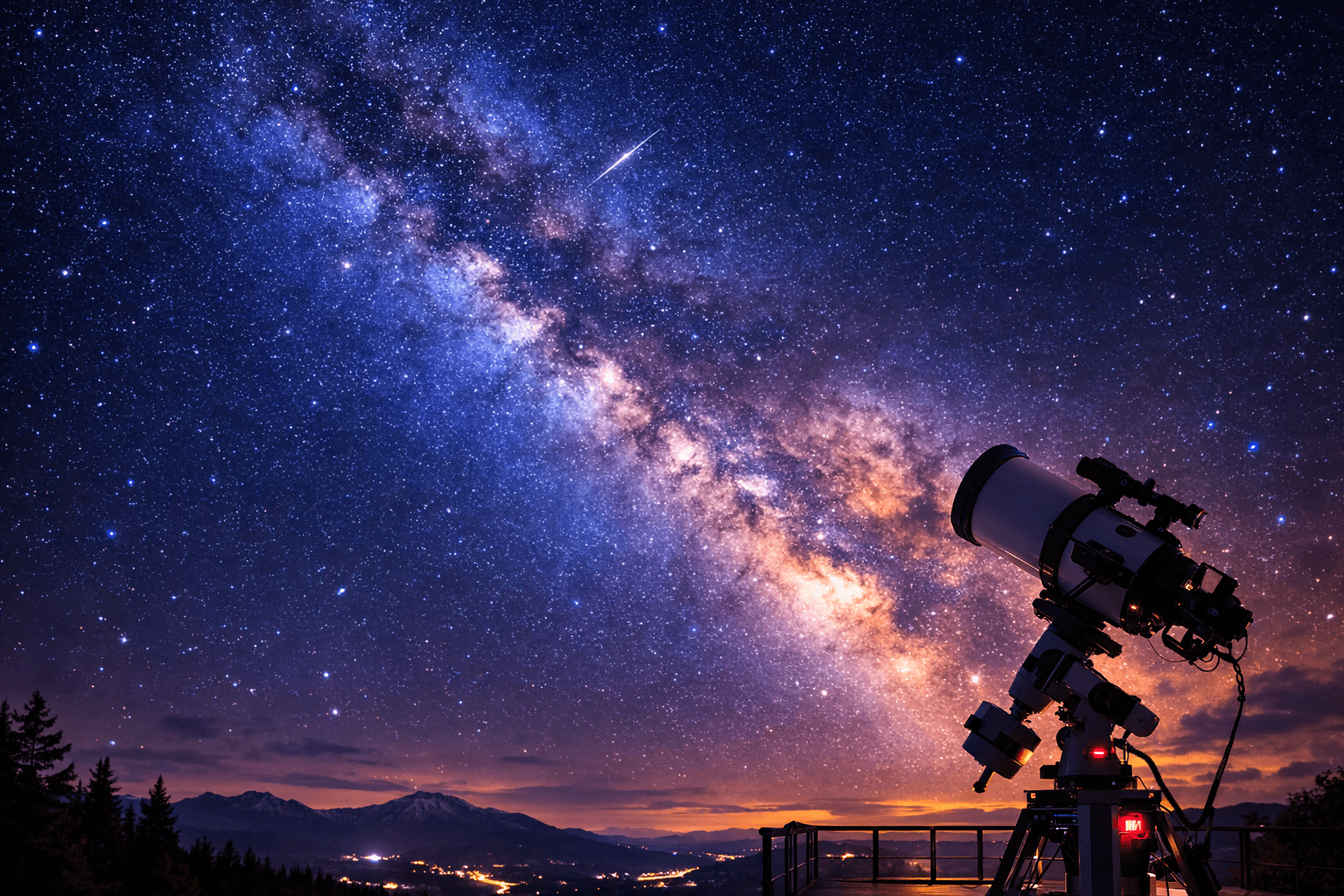
- Bortle 1 — Excellent dark site: The zodiacal light is prominently visible. Airglow (the natural atmospheric glow) is visible as a faint, structured band. M33 (Triangulum Galaxy) is naked-eye visible. The Milky Way casts faint shadows on white paper. Less than 1% of the world's population lives under skies this dark.
- Bortle 2 — Typical truly dark site: The zodiacal band is visible. Airglow is visible on the horizon. Most serious amateur observatories target Bortle 2.
- Bortle 3 — Rural sky: Some light pollution evident on the horizon from distant towns. The Milky Way structure is vivid and detailed.
- Bortle 4 — Rural/suburban transition: Milky Way still impressive, but city light domes visible. The sky is noticeably brighter near the horizon.
- Bortle 5 — Suburban sky: The Milky Way is washed out near the horizon and lacks structure. Most backyard astrophotographers image from Bortle 5–6.
- Bortle 6–7 — Bright suburban: The Milky Way is barely detectable or invisible. Faint nebulosity requires long exposure or narrowband filters.
- Bortle 8–9 — City sky: Only the Moon, planets, and a few hundred stars are visible. Deep-sky broadband imaging is essentially impossible.
Why Sky Darkness Matters More Than Equipment
Light pollution isn't just an annoyance — it's direct signal contamination. When you image under a bright sky, the sky background itself floods your sensor with photons. This creates a noise floor that fundamentally limits how faint you can detect signal, regardless of how much equipment you throw at the problem.
The numbers are striking:
- A Bortle 5 sky background is approximately 10× brighter than Bortle 2
- A Bortle 7 sky is roughly 40× brighter than Bortle 1
- A 30-minute integration from a Bortle 1 site often produces better faint nebulosity than a 10-hour integration from Bortle 6
This is not metaphorical. The signal-to-noise math is brutal: when your sky background overwhelms your target signal, additional exposure time helps less and less. Eventually you hit a ceiling that no amount of stacking can overcome.
Measuring Sky Darkness: The SQM
The Bortle scale can be precisely quantified using a Sky Quality Meter (SQM), measuring in magnitudes per square arcsecond (mag/arcsec²). Each magnitude corresponds to a 2.5× brightness difference:
- Bortle 1: SQM ≥ 22.0 mag/arcsec²
- Bortle 3: SQM ≈ 21.5 mag/arcsec²
- Bortle 5: SQM ≈ 20.0 mag/arcsec²
- Bortle 7: SQM ≈ 18.5 mag/arcsec²
- Bortle 9: SQM < 17.5 mag/arcsec²
The 3.5-magnitude difference between Bortle 1 and Bortle 5 means the sky is approximately 25× darker. That's 25× less sky noise contaminating every pixel of your image.
Where Are the Bortle 1 Sites?
True Bortle 1 skies exist only in remote locations far from any human settlement. The world's premier sites:
- Atacama Desert, Chile: The world's premier astronomical observing site. Extreme altitude (2,400–5,000m), near-zero humidity, exceptional seeing, and 320+ clear nights per year. Home to ESO's VLT, ALMA, and dozens of remote observatory networks. The same conditions that justified building the world's most expensive telescopes here.
- Roque de los Muchachos, La Palma (Canary Islands): Bortle 1–2, northern hemisphere. Site of the Gran Telescopio Canarias.
- NamibRand Nature Reserve, Namibia: Certified as an International Dark Sky Reserve. Exceptional for southern sky targets.
- Remote New Mexico / West Texas: Bortle 2–3. Classic amateur dark sky destinations.
The SkyShare Astro observatory is located in the Atacama Desert at approximately 2,400m elevation — a confirmed Bortle 1 site. Our images are captured from conditions that professional observatories specifically chose for their unmatched quality.
Narrowband: A Partial Solution for Light-Polluted Skies
If you're imaging from a Bortle 5–7 environment, narrowband filters offer a powerful workaround. By isolating specific emission wavelengths from ionized gas (hydrogen-alpha at 656nm, OIII at 500nm), ultra-narrow filters with 3–5nm bandpass block the vast majority of broadband light pollution.
Narrowband from a light-polluted sky can produce results competitive with broadband from Bortle 3–4. But it doesn't help for reflection nebulae, galaxies, or star clusters — and even narrowband from Bortle 1 significantly outperforms narrowband from Bortle 6.
Finding Dark Skies: Practical Tools
The Light Pollution Map displays satellite-measured sky brightness worldwide. Use it to locate the nearest Bortle 3 or darker site within driving distance.
But if a several-hour drive to a dark site isn't practical — or if you want Bortle 1 quality without the trip — remote telescope rental is the answer. Book a session on our Atacama telescope and image from the world's darkest accessible skies, tonight, from wherever you are.
Sky darkness isn't a variable you optimize around. It's the foundation everything else is built on.